Full-Stack AI: Integrating Machine Learning Across Frontend & Backend
SaaS content writer helping tech brands turn features into benefits. Passionate about simplifying complex ideas. | Let’s connect!
Artificial intelligence is no longer a futuristic add-on—it has quickly become a core part of modern software architecture. From personalized user experiences to intelligent automation and real-time insights, AI has transformed how applications behave and how users interact with technology. But in 2025, the biggest shift is not just using AI in isolated parts of a system; it’s about integrating machine learning across the entire software stack.
This evolution is known as Full-Stack AI.
Instead of limiting machine learning to backend analytics or standalone APIs, full-stack AI embeds intelligence in both frontend interfaces and backend systems. This approach creates more responsive, adaptive, and user-centric digital experiences. Today, every forward-thinking Software Development Company is embracing this transformation to build applications that are not just functional—but predictive, human-like, and context-aware.
This article explores how full-stack AI works, why it’s reshaping the software world, and how businesses can leverage it to build smarter and more scalable digital products.
The Rise of Full-Stack AI: A New Era of Intelligent Applications
Traditional software development follows a predictable pattern—frontend for user interaction, backend for logic, and databases for storage. Machine learning was typically treated as an isolated layer, often running on the backend or third-party cloud services.
But user expectations have evolved dramatically. They now want:
Instant recommendations
Smart search
Context-aware UI changes
Real-time personalization
Voice/chat interactions
Intelligent automation
To meet these expectations, AI needs to be everywhere—not just in the backend, but also at the user interface level. This shift has led to the rise of Full-Stack AI, where the frontend and backend collaborate seamlessly to deliver intelligent behavior in real time.
A modern Software Development Company that understands this architecture can transform outdated applications into dynamic, AI-powered digital ecosystems.
Why Full-Stack AI Matters in 2025
The business landscape has embraced AI not just for automation, but as a competitive advantage. Full-stack AI enables:
1. Hyper-Personalized User Experiences
Apps can now understand behavior, predict actions, and customize UI elements on the fly.
Example: A shopping app that rearranges products based on your browsing patterns in real time.
2. Reduced Latency with On-Device ML
Frontend AI models—powered by TensorFlow.js, ONNX.js, and MediaPipe—run directly on a user’s browser or device.
This reduces dependency on cloud servers and improves responsiveness.
3. Smarter Backend Decisions
Backend AI can perform heavy lifting like fraud detection, forecasting, NLP processing, and intelligent routing.
This helps automate business workflows and elevate operational efficiency.
4. End-to-End Intelligence
Frontend collects insights → Backend processes them → AI iteratively improves the system.
It’s a continuous learning loop.
5. Cost-Effective Scalability
Instead of overloading servers with ML inference, parts of the workload shift to the frontend.
This prevents expensive cloud resource usage.
With full-stack AI, businesses reduce operational costs while dramatically improving user experience. That’s why companies collaborate with an advanced Software Development Company to implement these capabilities efficiently.
How Machine Learning Works in the Frontend Layer
The frontend is no longer a simple UI layer; it has become a smart, responsive, and adaptive environment thanks to embedded machine learning.
Key Technologies Enabling Frontend AI
TensorFlow.js – Runs ML models directly in the browser
ONNX.js – Executes optimized AI models on the client side
MediaPipe – Real-time face, gesture, and object detection
WebGPU/WebAssembly – Speeds up model processing for high performance
Practical Frontend AI Use Cases
1. Real-Time Recommendations
Product recommendations change instantly based on user clicks and scroll patterns.
2. Personalized UI Updates
Layout, colors, notifications, and content become user-specific.
3. Image & Video Processing
Real-time background removal, AR filters, eye tracking, gesture detection—done directly in the browser.
4. Smart Form Validation
AI predicts what users want to input, preventing errors and improving UX.
5. Chatbots and Intelligent Assistants
AI-driven conversational interfaces embedded directly into the UI.
6. Accessibility Enhancements
Caption generation, voice commands, and screen reader improvements powered by ML.
With AI embedded into the frontend, applications become dynamic, helpful, and user-aware. A specialized Software Development Company ensures these features run smoothly without draining device performance.
How Machine Learning Works in the Backend Layer
The backend is the powerhouse of AI—where the heavy computation happens. It is responsible for training, serving, and optimizing machine learning models.
Common Backend AI Technologies
Python / FastAPI / Flask / Django
Node.js for real-time AI services
TensorFlow, PyTorch, Keras
LangChain and vector databases for RAG applications
Kubeflow, MLflow, Airflow for MLOps
Docker & Kubernetes for scalable model serving
Important Backend AI Use Cases
1. Prediction Engines
Forecasting sales, customer churn, delivery time, or business outcomes.
2. Recommendation Systems
Smart suggestions based on behavior, history, or user clusters.
3. Fraud & Anomaly Detection
Banks, eCommerce, and fintech platforms use backend AI extensively.
4. NLP and Text Intelligence
Sentiment analysis, document classification, summarization, and search optimization.
5. Automation Workflows
Approvals, ticket routing, email responses, and operational tasks handled by ML.
6. Voice & Speech Processing
Transcription, intent detection, and voice-driven actions.
Backend AI powers the logic and intelligence of the entire application ecosystem. Strategic guidance from a Software Development Company ensures these models integrate seamlessly with user-facing components.
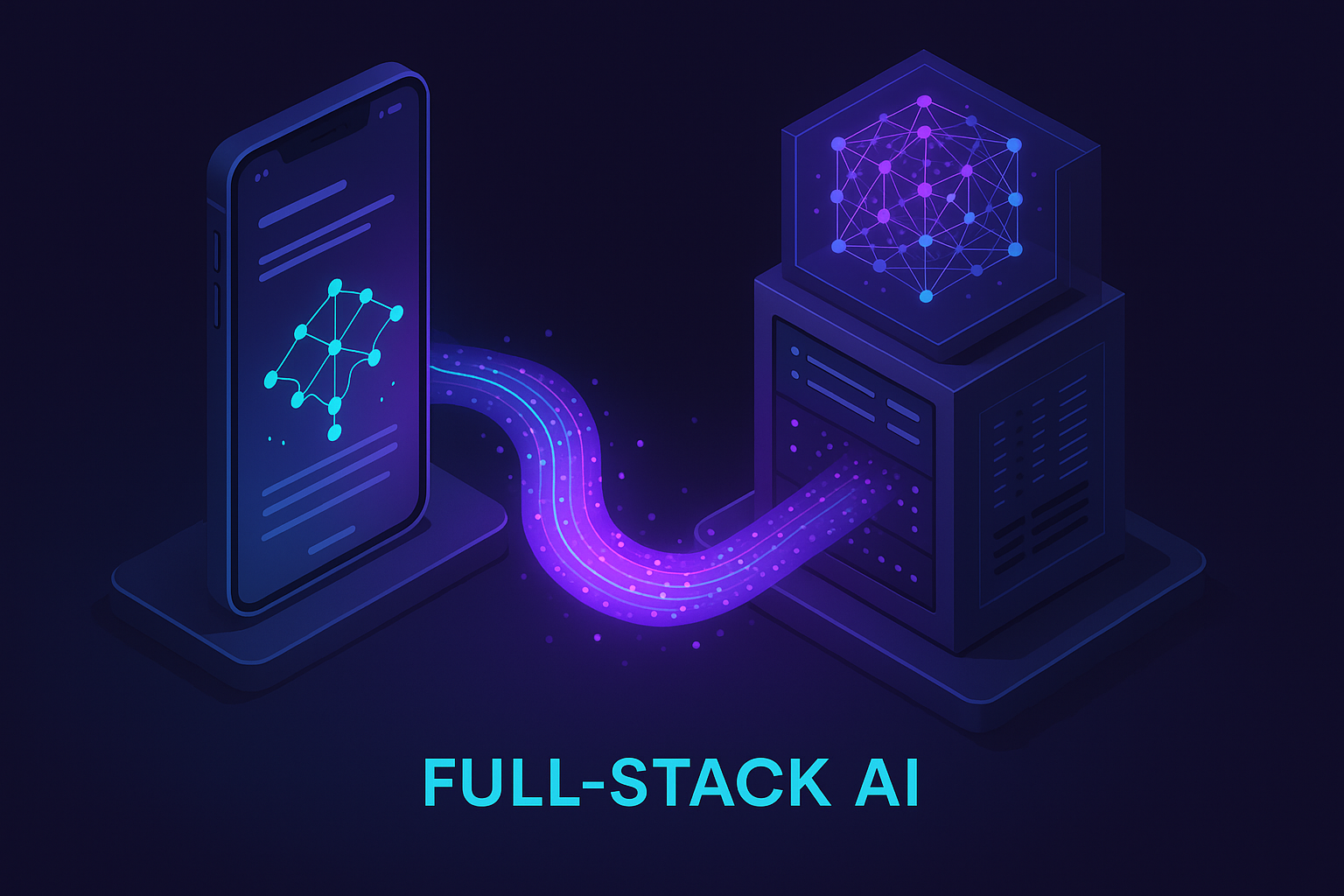
How Frontend and Backend AI Work Together: The Full-Stack Approach
Full-stack AI is not about adding separate AI features—it’s about building a connected intelligence system across the entire application.
Here’s how the flow works:
Frontend collects real-time insights
User behavior, gestures, session analytics, and input patterns.Backend processes and refines ML models
Heavy computation, batch training, and advanced modeling.AI-driven responses are sent back to the frontend
Dynamic UI updates, predictions, recommendations.Frontend AI models run lightweight tasks locally
On-device inference for minimal latency.Both layers learn from each other
Continuous feedback loops create smarter applications.
This creates a hyper-intelligent environment where apps behave more like digital companions than static platforms.
Full-Stack AI Architecture: What It Looks Like
A production-grade full-stack AI system includes:
Real-time data streaming (Kafka, Redis, Kinesis)
AI microservices for model inference
Frontend ML engines for lightweight tasks
Backend ML pipelines for training & optimization
APIs for communication between layers
Observability and telemetry for performance tracking
MLOps workflows for continuous improvement
This architecture ensures applications remain fast, accurate, reliable, and scalable as user demand grows.
Why Businesses Need Full-Stack AI to Stay Competitive
Full-stack AI is more than a technology trend—it’s a business necessity.
Companies that integrate AI across the stack experience:
1. Higher User Engagement
Smart UI interactions reduce bounce rates and increase retention.
2. Better Decision Making
Predictive analytics empower teams to act faster and smarter.
3. Increased Sales Through Personalization
AI-based recommendations dramatically improve conversions.
4. Reduced Operational Costs
Automation replaces manual workflows, saving time and money.
5. Better Scalability
AI-driven infrastructure management helps applications scale automatically.
With these advantages, partnering with a cutting-edge Software Development Company ensures businesses get AI solutions that are robust, secure, and future-ready.
How a Software Development Company Helps Build Full-Stack AI Applications
Implementing full-stack AI is complex—requiring expertise in frontend development, backend engineering, machine learning, and cloud infrastructure. A professional Software Development Company provides:
AI Strategy & Consulting
Mapping business needs to the right ML solutions.
End-to-End AI Model Development
Data pipelines, model training, and deployment.
Frontend + Backend AI Integration
Seamlessly embedding AI across the entire stack.
MLOps & Continuous Training Pipelines
Ensuring models remain accurate over time.
Cloud-Native AI Deployment
AWS, Azure, and Google Cloud ML infrastructures.
Performance Optimization & Scalability
Ensuring ultra-fast prediction response times.
Security & Compliance
Protecting data, models, and APIs from threats.
A skilled development partner makes AI integration smooth, scalable, and aligned with business goals.
The Future of Full-Stack AI
As AI models become more powerful and lightweight, the boundaries between frontend and backend will continue to dissolve. The future will bring:
AI-first UI frameworks
On-device LLMs for privacy and speed
Context-aware digital assistants embedded in every app
Self-optimizing applications that learn without redeployment
Serverless AI microservices
In the years ahead, every successful digital product will be AI-driven from top to bottom. Organizations that adopt full-stack AI now will lead the next wave of innovation.
Final Thoughts
Full-stack AI represents a major shift in how applications are designed, built, and experienced. By integrating machine learning across both the frontend and backend, businesses can create digital products that are intelligent, fast, adaptive, and deeply personalized.
Partnering with a reliable Software Development Company ensures your AI journey is smooth, strategic, and scalable—helping you stay ahead in a competitive digital landscape.


